



- This is not positioned as an initiation or dose-change service.
- Eligibility depends on an established prescription and the service’s listed scope.
- A product page cannot determine whether a medicine is clinically suitable for a particular person.
- The separate menopause test listing should not be mistaken for prescription review.
Why the repeat boundary matters
- It makes the intended reader easier to identify: someone already stable on treatment.
- It leaves new symptoms and treatment changes with the appropriate clinician.
- It means the visible range is reference information, not a recommendation to switch.
Questions to settle before relying on a repeat pathway
Before applying, check that the exact medicine appears in the service’s current scope and that the prescription remains unchanged. Confirm what records or details are needed and how the prescriber review works if the request cannot be matched to the information supplied. Those details shape convenience more than a broad claim about online access. Check whether the pathway includes the exact prescribed product by reviewing the relevant Ovesse page or Gina page where applicable.
Also decide where you would go if your situation has changed. The repeat service may be suitable for continuity, but a new concern calls for a clinical review that can assess the change. The responsible prescriber can explain whether the current regimen remains appropriate and what next step is needed.

A listing such as Ovesse can help identify a prescribed product, while a non-HRT item such as V-san belongs to a different category. This distinction is useful when browsing: related symptoms do not make products equivalent, and retail descriptions should not be used to alter a prescribed plan. The Ovesse listing and Gina listing are useful only as product references.
Is PillSorted’s HRT repeat service a good fit for you?
Our view is that PillSorted is worth considering for continuity if you already have a stable, listed HRT prescription and want a UK pharmacy to review a repeat request. Its scope is clearest where the medicine and dose are settled, and the product listings give concrete reference points for checking names and formats.
The limitation is decisive for anyone seeking a first prescription, a change or advice about new symptoms: this service says it does not provide those steps. In that situation, contact the clinician responsible for your care. For a stable repeat, first confirm eligibility and the exact product details on PillSorted’s current pages.
A repeat pathway is easiest to assess when the reader can answer a few practical questions before beginning. PillSorted says it checks product and dose details; therefore, consistency between the request and the current prescription is central to the service’s stated model.
- Confirm the exact product name and strength on the current prescription.
- Check whether the existing prescription is stable and falls within the service’s listed scope.
- Have relevant details available for the prescriber review, including any change in treatment.
- Ask the prescribing clinician about new symptoms or a possible adjustment instead of using a repeat request to make that change.
The brand also lists a Flourish Menopause Test Kit. That is a separate listing, not a substitute for an HRT assessment or a route to a repeat prescription. A test product and a prescription medicine serve different purposes; readers should check the listing’s stated use and discuss symptoms with an appropriate clinician.

Similarly, Flourish should be understood from its own product information, while the repeat service should be assessed from its eligibility and review terms. Keeping those paths separate helps avoid the impression that a test result or shop category alone settles a treatment decision. Readers considering the Flourish test kit should read its listing independently of the HRT repeat terms.
Where the service earns its place
The clearest strength is focus. A pathway for established prescriptions can make sense for a reader who is stable, knows the exact medicine and wants a pharmacy to review a repeat request. PillSorted also explains the line it draws around initiation and changes, which helps readers identify when they need a different kind of appointment.
There is also practical value in seeing real product pages alongside the service description. Ovesse and Gina give concrete examples of how the catalog distinguishes forms. This may help a reader check whether they are looking at the same prescribed product, while keeping the choice with their clinician.
The limits a reader should weigh
- This is not positioned as an initiation or dose-change service.
- Eligibility depends on an established prescription and the service’s listed scope.
- A product page cannot determine whether a medicine is clinically suitable for a particular person.
- The separate menopause test listing should not be mistaken for prescription review.
Why the repeat boundary matters
- It makes the intended reader easier to identify: someone already stable on treatment.
- It leaves new symptoms and treatment changes with the appropriate clinician.
- It means the visible range is reference information, not a recommendation to switch.
Questions to settle before relying on a repeat pathway
Before applying, check that the exact medicine appears in the service’s current scope and that the prescription remains unchanged. Confirm what records or details are needed and how the prescriber review works if the request cannot be matched to the information supplied. Those details shape convenience more than a broad claim about online access. Check whether the pathway includes the exact prescribed product by reviewing the relevant Ovesse page or Gina page where applicable.
Also decide where you would go if your situation has changed. The repeat service may be suitable for continuity, but a new concern calls for a clinical review that can assess the change. The responsible prescriber can explain whether the current regimen remains appropriate and what next step is needed.
A listing such as Ovesse can help identify a prescribed product, while a non-HRT item such as V-san belongs to a different category. This distinction is useful when browsing: related symptoms do not make products equivalent, and retail descriptions should not be used to alter a prescribed plan. The Ovesse listing and Gina listing are useful only as product references.
Is PillSorted’s HRT repeat service a good fit for you?
Our view is that PillSorted is worth considering for continuity if you already have a stable, listed HRT prescription and want a UK pharmacy to review a repeat request. Its scope is clearest where the medicine and dose are settled, and the product listings give concrete reference points for checking names and formats.
The limitation is decisive for anyone seeking a first prescription, a change or advice about new symptoms: this service says it does not provide those steps. In that situation, contact the clinician responsible for your care. For a stable repeat, first confirm eligibility and the exact product details on PillSorted’s current pages.
- The pathway is intended for people already stable on a listed HRT prescription.
- PillSorted says a UK-registered prescriber checks current product and dose details.
- The catalog includes distinct formats, including cream and vaginal tablets.
- The service says it will not initiate or change HRT, which limits its fit for new treatment decisions.
A repeat route with a deliberately narrow remit
PillSorted is an online UK pharmacy whose HRT repeat pathway is framed around continuity. Its description says that a prescriber reviews current treatment details before supply. That is a meaningful safeguard: a repeat request is still subject to clinical review rather than being treated as an automatic checkout.
The boundary matters just as much. The service says it does not start HRT or alter a prescription. If symptoms have changed, a dose needs reconsideration, or treatment has not yet been prescribed, this pathway does not appear to be the right clinical doorway. The brand’s own wording makes an important distinction between repeating a settled plan and making a new treatment decision. Readers can review the Ovesse product page or Gina listing as examples, while keeping prescribing questions with their clinician.
This makes the service most relevant to someone who already knows what they take and can provide accurate prescription details. The process may reduce friction around obtaining a repeat, but it cannot replace a conversation with the clinician responsible for initiating or reviewing treatment. Readers should resolve uncertainty with their prescriber rather than treating a product listing as a recommendation.
The products show why “HRT” is not one routine
The store’s catalog gives useful context without making its products interchangeable. For example, Ovesse 1mg/g Vaginal Cream is listed as a cream supplied with an applicator. The presentation makes its local application format visible, but a product page alone cannot establish whether it suits an individual or whether a repeat request will be approved.
Another example is Gina 10 micrograms Vaginal Tablets, listed as vaginal tablets with applicators. Its format differs from a cream, and the details that matter to a patient include the prescribed product, how it was directed to be used and whether the listing matches the existing prescription. Those are questions for the prescriber and pharmacy review, not a reason to switch based on convenience. The current details for Gina and Ovesse can be checked on their respective PillSorted pages.
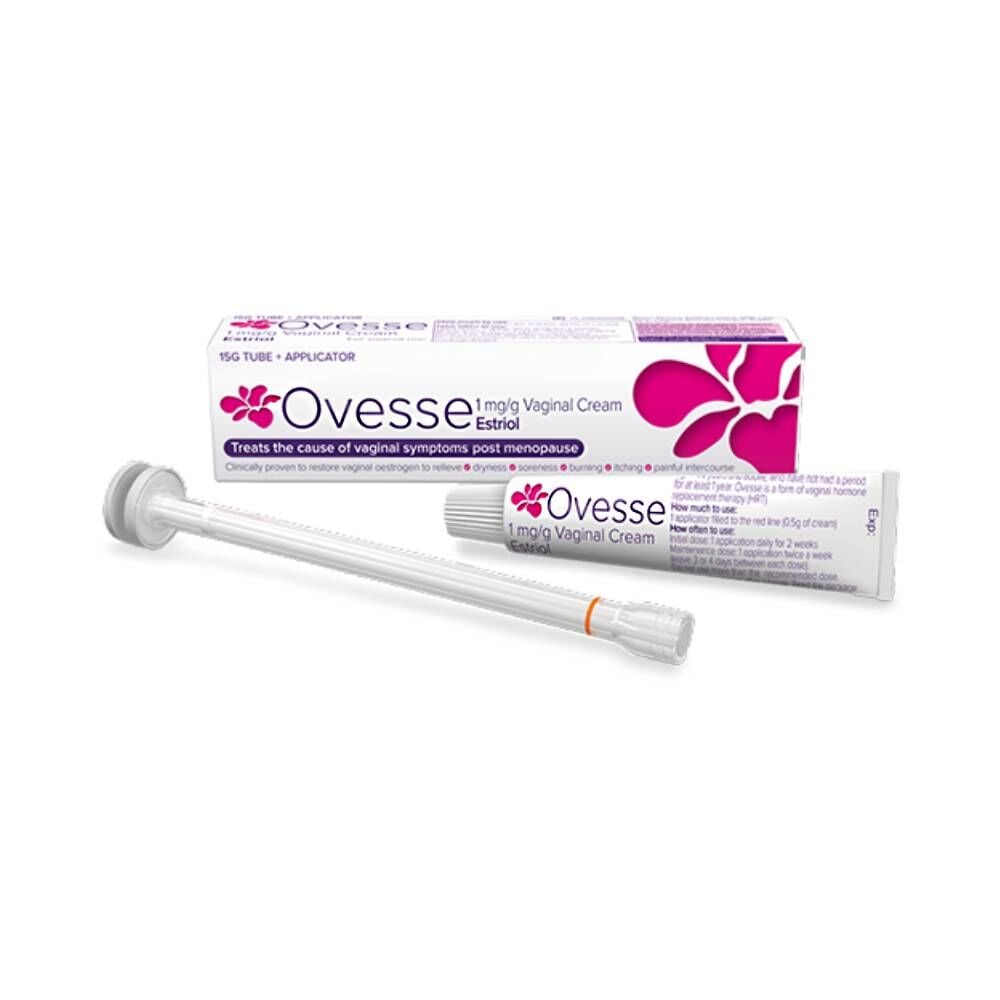
For readers comparing a current product listing with their paperwork, Ovesse and Gina are concrete examples of the range. The names, strength and formulation on the listing need to line up with the established prescription. If something differs, pause and check with the clinician or pharmacist; do not infer equivalence from a shared menopause category.

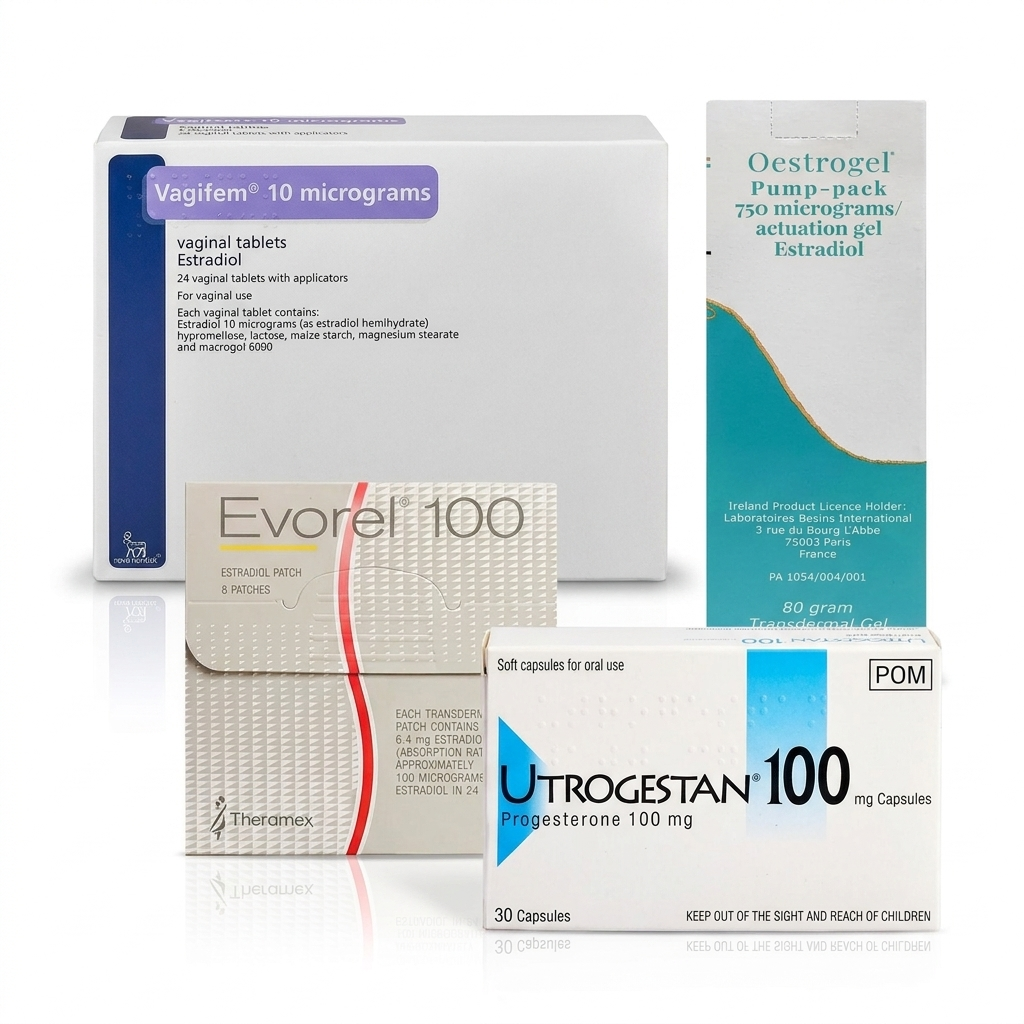
The wider HRT collection also displays other formulations. A range page helps readers understand that products may be creams, tablets, gels or patches, but it should not be read as a menu from which to self-select. Which medicines are appropriate, and how they are used, depend on the prescription and clinical context.
What to have ready for a repeat request
A repeat pathway is easiest to assess when the reader can answer a few practical questions before beginning. PillSorted says it checks product and dose details; therefore, consistency between the request and the current prescription is central to the service’s stated model.
- Confirm the exact product name and strength on the current prescription.
- Check whether the existing prescription is stable and falls within the service’s listed scope.
- Have relevant details available for the prescriber review, including any change in treatment.
- Ask the prescribing clinician about new symptoms or a possible adjustment instead of using a repeat request to make that change.
The brand also lists a Flourish Menopause Test Kit. That is a separate listing, not a substitute for an HRT assessment or a route to a repeat prescription. A test product and a prescription medicine serve different purposes; readers should check the listing’s stated use and discuss symptoms with an appropriate clinician.
Similarly, Flourish should be understood from its own product information, while the repeat service should be assessed from its eligibility and review terms. Keeping those paths separate helps avoid the impression that a test result or shop category alone settles a treatment decision. Readers considering the Flourish test kit should read its listing independently of the HRT repeat terms.
Where the service earns its place
The clearest strength is focus. A pathway for established prescriptions can make sense for a reader who is stable, knows the exact medicine and wants a pharmacy to review a repeat request. PillSorted also explains the line it draws around initiation and changes, which helps readers identify when they need a different kind of appointment.
There is also practical value in seeing real product pages alongside the service description. Ovesse and Gina give concrete examples of how the catalog distinguishes forms. This may help a reader check whether they are looking at the same prescribed product, while keeping the choice with their clinician.
The limits a reader should weigh
- This is not positioned as an initiation or dose-change service.
- Eligibility depends on an established prescription and the service’s listed scope.
- A product page cannot determine whether a medicine is clinically suitable for a particular person.
- The separate menopause test listing should not be mistaken for prescription review.
Why the repeat boundary matters
- It makes the intended reader easier to identify: someone already stable on treatment.
- It leaves new symptoms and treatment changes with the appropriate clinician.
- It means the visible range is reference information, not a recommendation to switch.
Questions to settle before relying on a repeat pathway
Before applying, check that the exact medicine appears in the service’s current scope and that the prescription remains unchanged. Confirm what records or details are needed and how the prescriber review works if the request cannot be matched to the information supplied. Those details shape convenience more than a broad claim about online access. Check whether the pathway includes the exact prescribed product by reviewing the relevant Ovesse page or Gina page where applicable.
Also decide where you would go if your situation has changed. The repeat service may be suitable for continuity, but a new concern calls for a clinical review that can assess the change. The responsible prescriber can explain whether the current regimen remains appropriate and what next step is needed.
A listing such as Ovesse can help identify a prescribed product, while a non-HRT item such as V-san belongs to a different category. This distinction is useful when browsing: related symptoms do not make products equivalent, and retail descriptions should not be used to alter a prescribed plan. The Ovesse listing and Gina listing are useful only as product references.
Is PillSorted’s HRT repeat service a good fit for you?
Our view is that PillSorted is worth considering for continuity if you already have a stable, listed HRT prescription and want a UK pharmacy to review a repeat request. Its scope is clearest where the medicine and dose are settled, and the product listings give concrete reference points for checking names and formats.
The limitation is decisive for anyone seeking a first prescription, a change or advice about new symptoms: this service says it does not provide those steps. In that situation, contact the clinician responsible for your care. For a stable repeat, first confirm eligibility and the exact product details on PillSorted’s current pages.
A close look at PillSorted’s UK repeat HRT pathway, its product examples and the limits that matter before you apply.
When a prescription is already established, the practical question is often how to keep obtaining it without losing the clinical checks around it. PillSorted presents a repeat service for eligible people whose HRT prescription is stable and already listed in its pathway.
That defined role is the most useful way to assess the offer. The store’s treatment pages show familiar medicines and formats, but the repeat service is not presented as a way to choose a first treatment or change an existing plan.
Some links in this article are affiliate links: if you make a purchase through them, we may receive a small commission.
Highlights
- The pathway is intended for people already stable on a listed HRT prescription.
- PillSorted says a UK-registered prescriber checks current product and dose details.
- The catalog includes distinct formats, including cream and vaginal tablets.
- The service says it will not initiate or change HRT, which limits its fit for new treatment decisions.
A repeat route with a deliberately narrow remit
PillSorted is an online UK pharmacy whose HRT repeat pathway is framed around continuity. Its description says that a prescriber reviews current treatment details before supply. That is a meaningful safeguard: a repeat request is still subject to clinical review rather than being treated as an automatic checkout.
The boundary matters just as much. The service says it does not start HRT or alter a prescription. If symptoms have changed, a dose needs reconsideration, or treatment has not yet been prescribed, this pathway does not appear to be the right clinical doorway. The brand’s own wording makes an important distinction between repeating a settled plan and making a new treatment decision. Readers can review the Ovesse product page or Gina listing as examples, while keeping prescribing questions with their clinician.
This makes the service most relevant to someone who already knows what they take and can provide accurate prescription details. The process may reduce friction around obtaining a repeat, but it cannot replace a conversation with the clinician responsible for initiating or reviewing treatment. Readers should resolve uncertainty with their prescriber rather than treating a product listing as a recommendation.
The products show why “HRT” is not one routine
The store’s catalog gives useful context without making its products interchangeable. For example, Ovesse 1mg/g Vaginal Cream is listed as a cream supplied with an applicator. The presentation makes its local application format visible, but a product page alone cannot establish whether it suits an individual or whether a repeat request will be approved.
Another example is Gina 10 micrograms Vaginal Tablets, listed as vaginal tablets with applicators. Its format differs from a cream, and the details that matter to a patient include the prescribed product, how it was directed to be used and whether the listing matches the existing prescription. Those are questions for the prescriber and pharmacy review, not a reason to switch based on convenience. The current details for Gina and Ovesse can be checked on their respective PillSorted pages.
For readers comparing a current product listing with their paperwork, Ovesse and Gina are concrete examples of the range. The names, strength and formulation on the listing need to line up with the established prescription. If something differs, pause and check with the clinician or pharmacist; do not infer equivalence from a shared menopause category.
The wider HRT collection also displays other formulations. A range page helps readers understand that products may be creams, tablets, gels or patches, but it should not be read as a menu from which to self-select. Which medicines are appropriate, and how they are used, depend on the prescription and clinical context.
What to have ready for a repeat request
A repeat pathway is easiest to assess when the reader can answer a few practical questions before beginning. PillSorted says it checks product and dose details; therefore, consistency between the request and the current prescription is central to the service’s stated model.
- Confirm the exact product name and strength on the current prescription.
- Check whether the existing prescription is stable and falls within the service’s listed scope.
- Have relevant details available for the prescriber review, including any change in treatment.
- Ask the prescribing clinician about new symptoms or a possible adjustment instead of using a repeat request to make that change.
The brand also lists a Flourish Menopause Test Kit. That is a separate listing, not a substitute for an HRT assessment or a route to a repeat prescription. A test product and a prescription medicine serve different purposes; readers should check the listing’s stated use and discuss symptoms with an appropriate clinician.
Similarly, Flourish should be understood from its own product information, while the repeat service should be assessed from its eligibility and review terms. Keeping those paths separate helps avoid the impression that a test result or shop category alone settles a treatment decision. Readers considering the Flourish test kit should read its listing independently of the HRT repeat terms.
Where the service earns its place
The clearest strength is focus. A pathway for established prescriptions can make sense for a reader who is stable, knows the exact medicine and wants a pharmacy to review a repeat request. PillSorted also explains the line it draws around initiation and changes, which helps readers identify when they need a different kind of appointment.
There is also practical value in seeing real product pages alongside the service description. Ovesse and Gina give concrete examples of how the catalog distinguishes forms. This may help a reader check whether they are looking at the same prescribed product, while keeping the choice with their clinician.
The limits a reader should weigh
- This is not positioned as an initiation or dose-change service.
- Eligibility depends on an established prescription and the service’s listed scope.
- A product page cannot determine whether a medicine is clinically suitable for a particular person.
- The separate menopause test listing should not be mistaken for prescription review.
Why the repeat boundary matters
- It makes the intended reader easier to identify: someone already stable on treatment.
- It leaves new symptoms and treatment changes with the appropriate clinician.
- It means the visible range is reference information, not a recommendation to switch.
Questions to settle before relying on a repeat pathway
Before applying, check that the exact medicine appears in the service’s current scope and that the prescription remains unchanged. Confirm what records or details are needed and how the prescriber review works if the request cannot be matched to the information supplied. Those details shape convenience more than a broad claim about online access. Check whether the pathway includes the exact prescribed product by reviewing the relevant Ovesse page or Gina page where applicable.
Also decide where you would go if your situation has changed. The repeat service may be suitable for continuity, but a new concern calls for a clinical review that can assess the change. The responsible prescriber can explain whether the current regimen remains appropriate and what next step is needed.
A listing such as Ovesse can help identify a prescribed product, while a non-HRT item such as V-san belongs to a different category. This distinction is useful when browsing: related symptoms do not make products equivalent, and retail descriptions should not be used to alter a prescribed plan. The Ovesse listing and Gina listing are useful only as product references.
Is PillSorted’s HRT repeat service a good fit for you?
Our view is that PillSorted is worth considering for continuity if you already have a stable, listed HRT prescription and want a UK pharmacy to review a repeat request. Its scope is clearest where the medicine and dose are settled, and the product listings give concrete reference points for checking names and formats.
The limitation is decisive for anyone seeking a first prescription, a change or advice about new symptoms: this service says it does not provide those steps. In that situation, contact the clinician responsible for your care. For a stable repeat, first confirm eligibility and the exact product details on PillSorted’s current pages.
PillSorted HRT Review: What Its Repeat Service Can and Cannot Do
